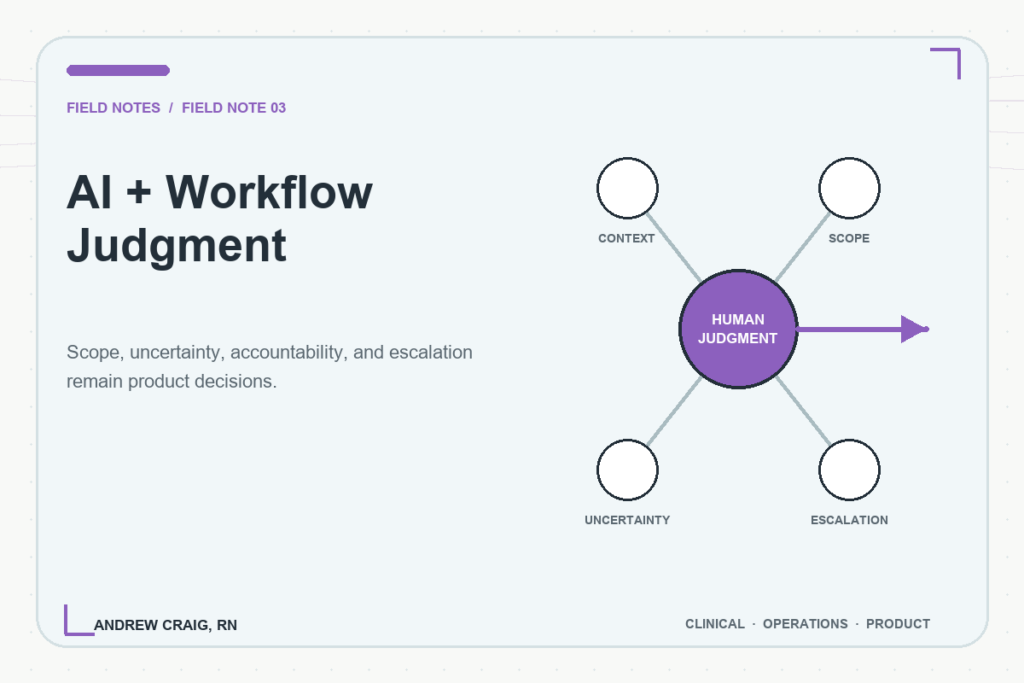
AI can summarize, classify, draft, retrieve, and automate parts of a workflow. Those capabilities are useful. They do not remove the need to decide what the system is allowed to do, what uncertainty means, and who remains accountable.
In healthcare, those questions are not legal language to add after the build. They are product requirements.
Start with the decision, not the model
Before choosing a tool, define the decision inside the workflow. Is the system organizing information, suggesting a next step, prioritizing attention, or acting without review? Each level changes the evidence, oversight, and failure handling required.
A prototype that produces a plausible answer demonstrates that the software can generate output. It does not establish that the output is reliable enough for the context or that people will use it appropriately.
Design for uncertainty
Responsible workflows make uncertainty visible. They define when the system should stop, what information is missing, when a person must review the result, and how a user can challenge or correct it.
Escalation should not be treated as failure. In many human systems, recognizing when not to proceed is a core capability.
Keep accountability legible
People should understand what the system contributed and what a qualified person decided. If responsibility becomes ambiguous, automation may increase speed while reducing trust.
The practical product test is straightforward: can the team explain the system’s scope, uncertainty, failure modes, escalation path, and accountable owner in plain language? If not, the workflow is not ready simply because the model works.